
THE MOVEMENT
A One Without Members
Disco became visible through records, clubs, photographs, films, fashions, and nights that entered popular memory, but its cultural significance cannot be contained within any one of them. It took shape through the interaction of people who did not share a single background, profession, or ambition, and who rarely imagined that their individual choices were contributing to something that would travel across continents and outlast the decade in which it emerged.
There was no central organisation directing its growth, no manifesto defining its principles, and no recognised membership through which one formally joined. Its reach developed through circulation: music passed from one city to another; dancers carried new forms of movement from clubs into studios and onto screens; photographers and designers gave the scene a visual identity; and audiences adapted what they encountered to their own places and lives. In that process, disco acquired the characteristics of a movement without ever being organised as one.
To understand why it became a global cultural force, it is therefore necessary to look beyond a chronology of songs and performers. The story lies equally in the historical conditions that made its emergence possible, in the many people who gave it form, in the creative language it produced, in the resistance provoked by its growing visibility, and in the ideas that survived after its commercial dominance had passed.
The Perfect Moment
Long before the word disco came to describe a musical style, several of the practices that would later shape it were already developing in different places, each in response to its own social and cultural setting. In post-war Paris, the discothèque established a form of nightlife centred on recorded music rather than live performance. Across northern England, dancers, collectors, and DJs built an intense culture around rare American soul records. In Italy, clubs were increasingly conceived as designed environments in which architecture, lighting, fashion, spectacle, and sound formed part of the same experience.
None of these scenes was disco, nor can any one of them be treated as its direct origin. What they reveal is a broader change in the relationship between music and social space: the record was no longer simply a reproduction of a performance, the DJ was acquiring a creative role of his or her own, and the club was becoming a destination whose atmosphere could be as important as the individual songs played within it.
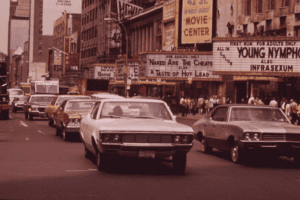
42nd Street, just west of Seventh Avenue, New York, 1973; Source: National Archives and Records Administration
At the beginning of the 1970s, the United States was undergoing a different kind of transformation. The Vietnam War, Watergate, economic uncertainty, and continuing struggles over civil rights had weakened confidence in established institutions, while Black, Latino, and LGBTQ+ communities, together with artists, musicians, and a generation testing inherited social conventions, were creating places in which identity could be expressed with greater freedom. These were not abstract debates conducted at a distance; they shaped who could enter a room, how people presented themselves, whom they could meet, and what kinds of public life were available to them.
New York provided the density, diversity, and creative friction in which these developments could converge. Private loft parties, underground gatherings, and a small number of pioneering DJs transformed recorded music into an extended sequence rather than a succession of isolated songs. The evening acquired its own architecture: sound was built gradually, dancers responded to one another, and the boundary between performer and audience became less distinct. What emerged was not simply a new way of listening, but a new way of occupying the same space.
There was no single night on which disco was invented. Its arrival was the result of social change, technological possibility, artistic experimentation, and human need meeting at a particular historical point. By the middle of the decade, those conditions had produced a form capable of moving rapidly beyond the communities and venues in which it first took shape.
The People
Disco was made by people whose roles were different but whose contributions were inseparable. Musicians and producers developed records with the physical and emotional demands of the dance floor in mind; DJs tested those records before an audience and discovered new possibilities in sequencing, repetition, and duration; dancers answered with gestures, styles, and energies that altered the atmosphere of the room. Around them, sound engineers, lighting designers, photographers, graphic artists, fashion designers, club owners, promoters, journalists, and record-industry workers translated an emerging scene into forms that could be heard, seen, reproduced, and carried elsewhere.
The people who entered those spaces came for no single reason. Some were devoted to the music, some followed friends, and others were drawn by work, curiosity, pleasure, romance, ambition, or the temporary release of becoming less accountable to the expectations of the outside world. For many whose lives were constrained by prejudice or convention, the club also offered an uncommon degree of visibility: not the promise that difference would disappear, but the possibility that it might be expressed without apology.
The dance floor did not abolish the inequalities beyond its doors, and its history should not be romanticised as one of effortless inclusion. Race, class, gender, sexuality, age, and status remained real, as did the exclusions produced by money, fashion, door policies, and social hierarchy. Yet within its most formative spaces, these categories could be rearranged. Authority belonged less to inherited position than to presence, style, musical knowledge, movement, and the ability to contribute to the intensity of a night shared with strangers.
This exchange between specialists and audiences made disco unusually porous. A dancer could influence a choreographer; a club photograph could shape fashion far from New York; a DJ’s response to a record could alter how the next one was produced. The movement was therefore not delivered to a passive public. It was continually revised by the people who inhabited it, including the countless participants whose names never entered the historical record but without whom the culture would not have existed.
The Culture
As disco expanded, it generated a language that could be recognised even when no record was playing. Light reflected from mirrored surfaces; typography borrowed the velocity and glamour of nightlife; clothes exaggerated movement and changed appearance under artificial illumination; photographs turned fleeting encounters into enduring images. The club brought these elements together, but their circulation through magazines, album covers, cinema, television, advertising, and retail carried them into everyday visual life.
Its environments were deliberately constructed. Sound systems were refined to produce a physical as well as musical experience, lighting responded to changes in mood and tempo, and interiors directed the movement of bodies through space. In the most ambitious venues, architecture, technology, performance, and social theatre became difficult to separate. A club was not merely a room in which culture happened; it was a medium through which culture was produced.

Georgetown University students looking through racks of records at a record store, Washington, D.C., 1979, Source: Library of Congress
The same principle shaped the music. Extended recordings, remixes, and continuous DJ sets loosened the conventional boundaries of the popular song, while dancers gave those innovations meaning through use. The relationship was circular: records altered movement, movement informed production, and the response of a crowd could determine which sounds travelled next. Disco’s creative force lay in this constant traffic between disciplines, industries, and audiences rather than in a fixed aesthetic programme.
By the end of the 1970s, its forms had become internationally legible, yet they were never reproduced in precisely the same way. Cities and communities absorbed disco into their own musical traditions, visual references, and social customs. Its global reach was not the spread of an unchanged American model, but a succession of local reinterpretations that made the culture both recognisable and continually new.
When Culture Meets Resistance
Visibility brought acceptance, commercial opportunity, and a scale that the earliest participants could scarcely have anticipated. It also exposed disco to hostility. By the late 1970s, the sound had entered mainstream radio, film, television, fashion, and advertising, while the people and attitudes associated with it occupied a public prominence that unsettled established expectations about taste, gender, sexuality, race, and who was entitled to shape popular culture.
Some criticism was directed at genuine excess: formulaic production, aggressive marketing, overcrowded releases, and an industry eager to attach the word disco to almost anything it could sell. Yet the language of the backlash frequently exceeded musical judgement. Mockery and anger were often aimed at the perceived artificiality, flamboyance, femininity, racial diversity, and queer visibility of the culture itself, allowing resistance to social change to present itself as a dispute about sound.
Disco Demolition Night on July 12, 1979, became the most enduring image of that reaction. Its destruction of records before a vast stadium audience has often been treated as the moment disco ended, but cultural history is rarely governed by such a clean rupture. Commercial fashion shifted, radio formats changed, and the name acquired a stigma in parts of the music industry; the practices developed through disco, however, moved into new scenes, technologies, and genres almost immediately.
The backlash altered the public narrative, but it could not reverse what had already happened. A culture formed through circulation did not depend on a single label for its survival.
The Legacy
Disco’s period of undisputed commercial dominance was brief, but duration is a poor measure of cultural consequence. The continuous set, the extended mix, the centrality of the DJ, the club as a designed environment, and the dance floor as a site of social and creative exchange became foundations on which later forms of music and nightlife were built. House, garage, techno, hip-hop, electronic dance music, and successive revivals did not simply quote disco; they inherited methods, structures, and possibilities that it had brought into focus.
Its visual legacy is equally persistent. Contemporary fashion, photography, performance, film, graphic design, and popular entertainment repeatedly return to the period’s materials and silhouettes, sometimes as historical reference and sometimes without acknowledging their source. More important than any recognisable style, however, is the idea that music, image, technology, place, and audience can be composed together to create an experience that belongs fully to none of them in isolation.
The social inheritance is more complex, and therefore more valuable. The freedoms associated with the dance floor were never complete, nor were they available equally to everyone, but the spaces in which disco first flourished demonstrated that nightlife could offer forms of recognition and encounter missing elsewhere. Every later venue that treats difference as a source of energy rather than a problem to be managed carries something of that history, whether consciously or not.
International Disco Day™ exists to preserve and interpret this living legacy: to honour the people who created it, to recognise the cultural forms it set in motion, and to keep its history available to new generations. Disco belongs to the past, but it has never remained there. Its movement continues wherever music reorganises a room, strangers become participants, and the possibilities of being together are briefly enlarged.